


Walking As Political Act
A Catalog Examining the Aesthetics and Politics of Migrant Movement
Data Viusalization
Publication Design
Collaboration with
Helena Cardona
Exhibition
Galeria de la Raza
Caminos al Andar
A Catalog Examining the Aesthetics and Politics of Migrant Movement
Data Viusalization
Publication Design
Collaboration with
Helena Cardona
Exhibition
Galeria de la Raza
Caminos al Andar
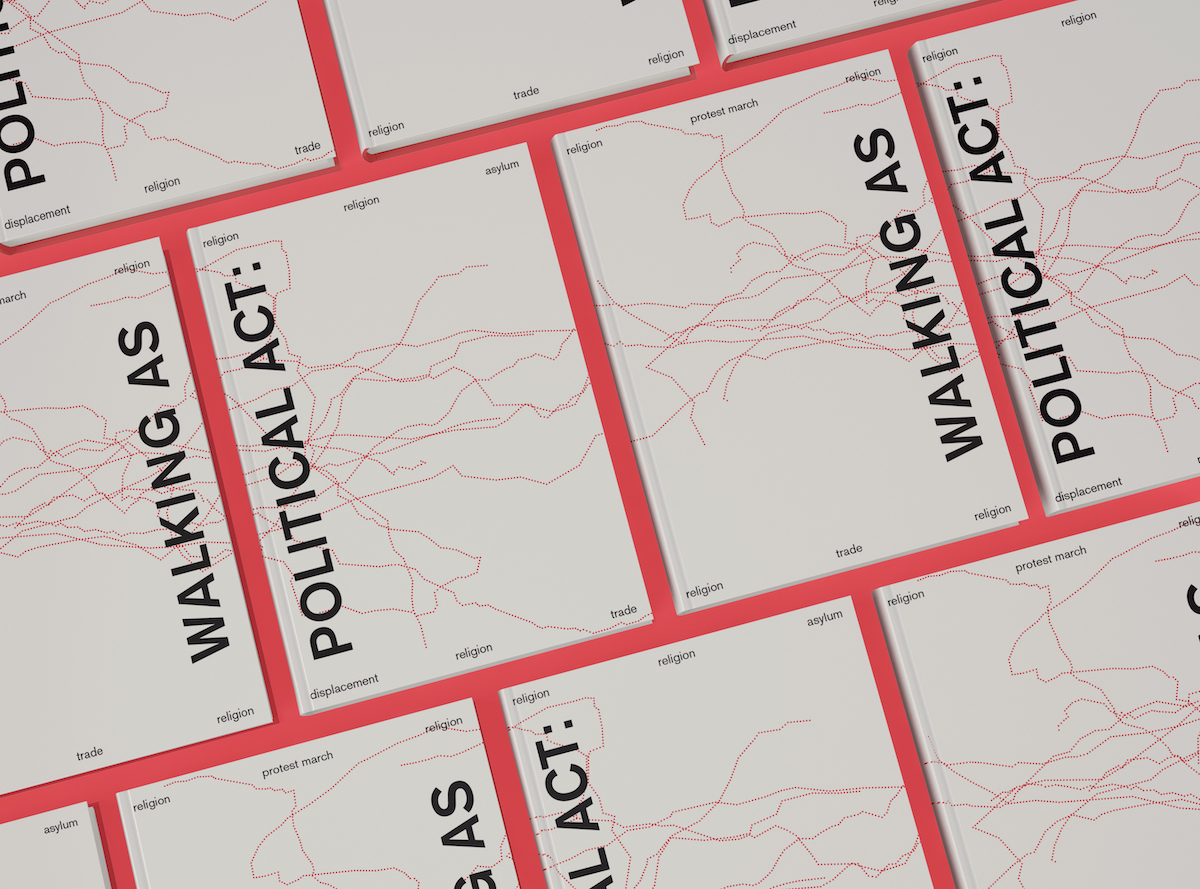
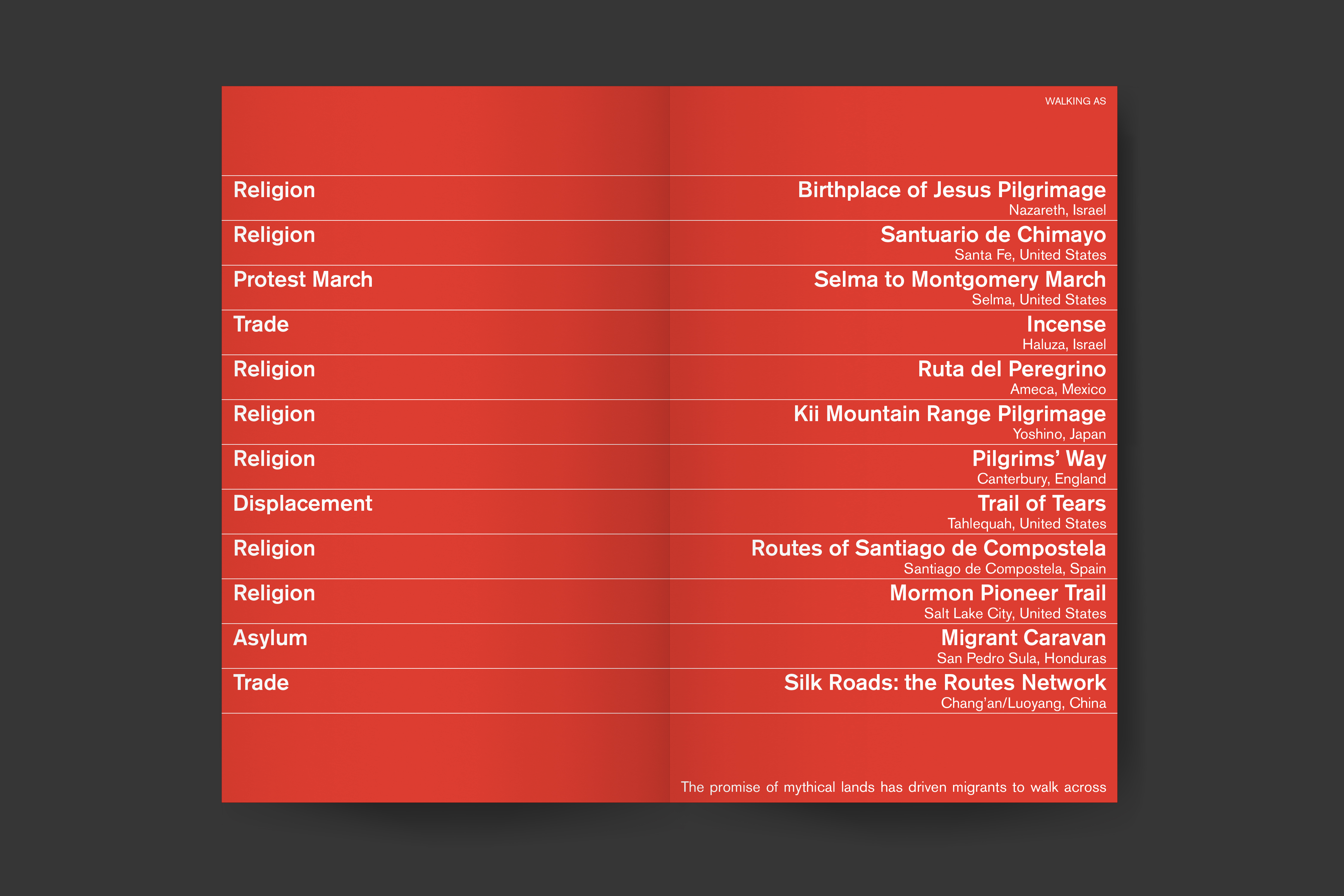
This publication investigates walking as a political act, framing migration not solely as a legal or territorial condition, but as a lived spatial experience. The catalog accompanies the exhibition Caminos al Andar and presents a comparative analysis of historically significant migrant journeys across time and geography.Rather than adopting a top-down narrative centered on borders and citizenship, the project reframes migration through the embodied experience of traversing landscape. The design system emphasizes time, distance, and terrain as primary narrative devices.
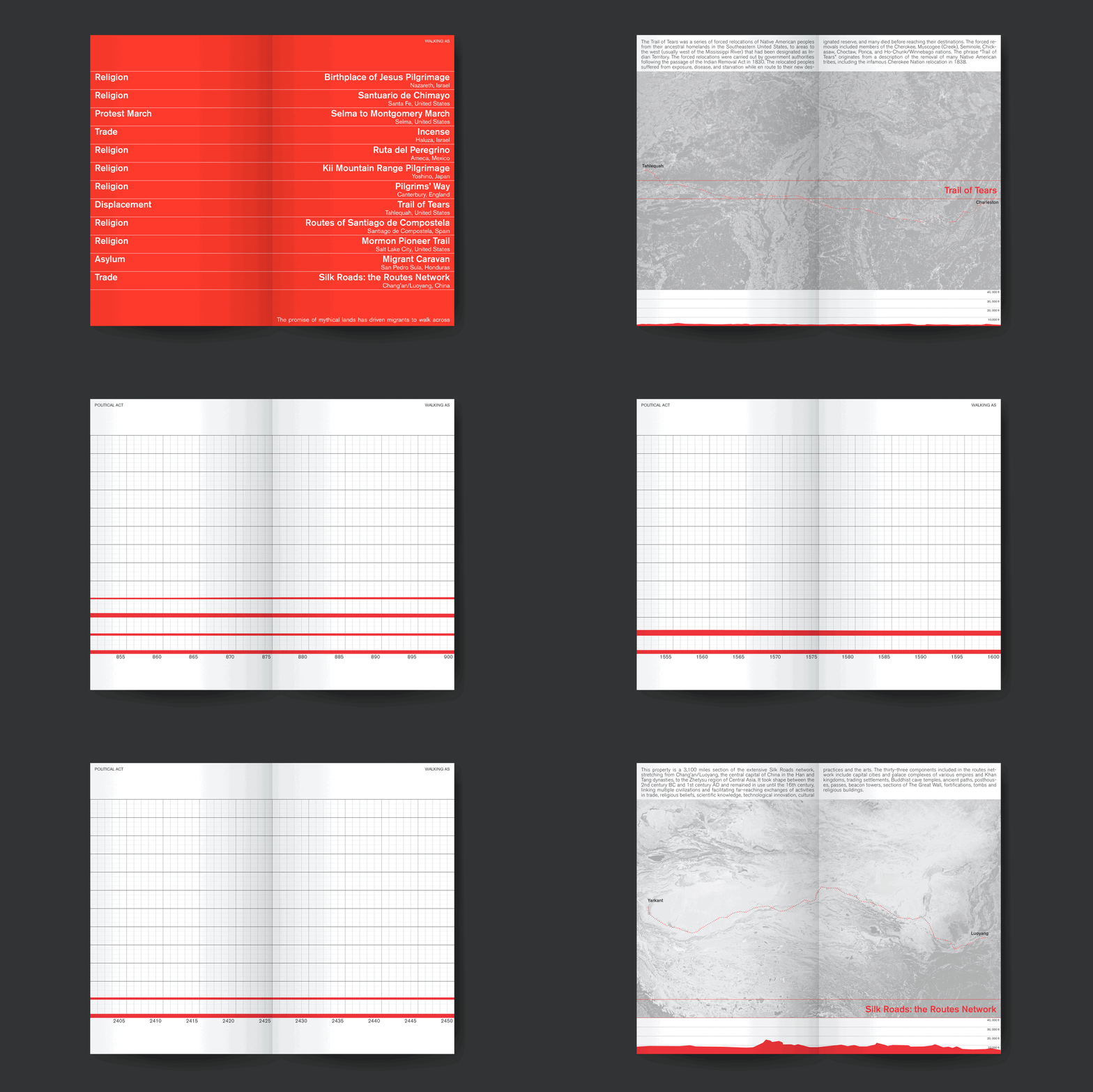
The publication was structured to visualize movement as both data and experience. Timed hourly estimations correlate with distances traveled, transforming abstract journeys into measurable human endurance. Cartographic trajectories were redrawn to create a consistent visual language across different historical walks. Sectional representations were introduced to reveal altitude variations. This decision shifts attention from geopolitical boundaries to the physical realities of landscape. Photography of traversed territories was integrated throughout the catalog, creating moments of pause that echo the cadence of walking itself.
The catalog positions representation as a political tool. If walking is an act of resistance, then design becomes a strategy for visibility — or, at times, intentional invisibility. By translating movement into measurable, visual systems, the publication invites readers to reconsider migration as an embodied and spatial condition rather than solely a bureaucratic one.
The publication was structured to visualize movement as both data and experience. Timed hourly estimations correlate with distances traveled, transforming abstract journeys into measurable human endurance. Cartographic trajectories were redrawn to create a consistent visual language across different historical walks. Sectional representations were introduced to reveal altitude variations. This decision shifts attention from geopolitical boundaries to the physical realities of landscape. Photography of traversed territories was integrated throughout the catalog, creating moments of pause that echo the cadence of walking itself.
The catalog positions representation as a political tool. If walking is an act of resistance, then design becomes a strategy for visibility — or, at times, intentional invisibility. By translating movement into measurable, visual systems, the publication invites readers to reconsider migration as an embodied and spatial condition rather than solely a bureaucratic one.